Introduction
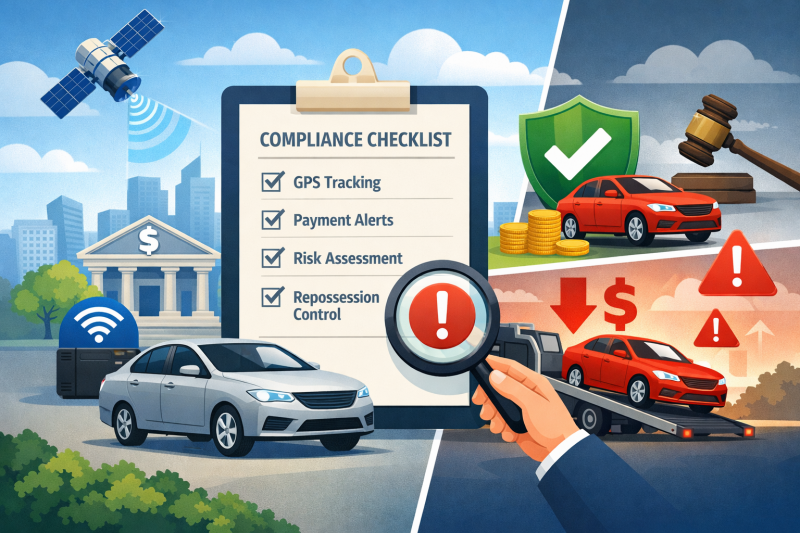
In today’s regulatory environment, GPS technology has become an important tool in automotive finance, helping lenders manage risk while meeting evolving compliance expectations.
Dealers and finance companies that utilize GPS tracking and starter interrupt solutions must ensure they are not only operating efficiently, but also legally, ethically, and consistently. Public enforcement actions across the country have highlighted recurring compliance failures involving disclosure gaps, privacy violations, procedural inconsistencies, and improper use of starter interrupt technology.
The message is clear: GPS compliance is no longer optional. It must be intentional, documented, audited, and enforced.
This article provides a practical framework for staying compliant and being able to prove it.
The Four Core Risk Areas in GPS Compliance
Recent enforcement trends show four primary areas of concern:
1. Disclosure Issues
2. Privacy Issues
3. Procedural Failures
4. Starter Interrupt Violations
Each of these areas exposes dealers and lenders to regulatory scrutiny, lawsuits, and reputational damage. The key to mitigation is implementing a structured compliance framework built around four pillars:
- GPS Technology
- Process & Documentation
- Audit & User Management
- Collection Team Compliance
1. Compliance Begins with the Technology
Compliance starts before the first vehicle is ever tracked. It begins with choosing the right GPS partner.
Privacy & Data Protection: Your GPS provider must follow the Safeguards Rule and Gramm-Leach-Bliley Act (GLBA)privacy guidelines. A documented data retention policy is essential, along with secure hosting environments and encryption standards.
System Reliability & Redundancy: Your provider should have redundancy across data centers, cellular carriers, GPS systems, and uptime infrastructure.
Training & Support: Quarterly training refreshers should be documented. Many dealers appoint a “GPS Champion” responsible for oversight and policy adherence.
2. Say What You Do – Do What You Say
Every dealer must have a clear written GPS policy defining:
- Who is authorized to use the system
- When GPS tracking is permitted
- What actions may be taken
- Geographic limitations
Your policy should clearly address the 5 W’s: Who, Why, When, What, and Where.
Customers must sign a GPS disclosure integrated into the RISC (Retail Installment Sales Contract) or closing documents. The disclosure should clearly state the vehicle is equipped with GPS and include a waiver of privacy concerning location, mileage, and accidents.
Have all employees sign internal GPS disclosures and NDAs to ensure accountability and prevent misuse.
3. Strict User Management & Audit Controls
Best practices include:
- Individual usernames (no shared passwords)
- Role-based permissions
- Business-hours-only access restrictions
- IP address limitations
- Immediate removal of access for terminated employees
- Mandatory password change reminders
Dealers should monitor user activity logs, conduct internal audits, and require annual vendor audit reports confirming proper data security measures.
4. Compliance Within the Collection Team
GPS tracking should only be used when a customer is delinquent, no exceptions.
Starter Interrupt systems are designed to interrupt the starter, not shut off a running vehicle. Proper installation ensures the system activates only when ignition and engine are off.
Certain states require prior warning before disabling a vehicle. Vehicles must be re-enabled promptly once payment is made.
Integration, Automation & Consistency
One of the strongest compliances advantages a dealer can have is proper DMS and payment processor integration with
their GPS platform.
DMS Integration & Documented Business Rules: DMS integration ensures that actions such as payment reminders or starter disable commands are triggered based on predefined, documented business rules — not employee discretion.
Payment processor integration adds another critical safeguard: When a payment is processed, the system can automatically send an Enable command, ensuring vehicles are While integration is central, your compliance framework should also clearly address:
- Uniform Reminder & Disable Policies - Applied consistently across all accounts
- 24/7 Emergency Starter Enable - To reduce safety and liability risks
- Smart Start Enable - Protection in low or no cellular coverage areas
- Bankruptcy Mode - Immediate blocking of reminders and disable commands for customers in BK
Together, these controls ensure your GPS program is not only operationally efficient, but defensible.
Federal vs. State Law
Currently, there is no federal law expressly prohibiting or permitting GPS or starter interrupt use. However, many states have specific legislation governing disclosure, right-to-cure provisions, timing of disable actions, and notice requirements.
Right-to-cure states require giving consumers a second chance to make up payments before repossession. Compliance programs must account for geographic variation.
Ituran - Your GPS Compliance Partner
At Ituran USA, we don’t just provide GPS technology, we support our dealers with the tools and guidance needed to operate confidently and compliantly.
If you would like assistance, email us today to request:
- A copy of GPS Disclosure form (English or Spanish)
- A suggested GPS Policy template (for internal use)
- Information regarding a specific State Bill or GPS-related legislation
Our team is here to help you strengthen your compliance program and reduce operational risk.
Conclusion
GPS technology is a powerful tool in automotive finance, helping protect assets and improve operational efficiency.
However, it must be managed responsibly.
By focusing on technology integrity, written policy, strict user management, and disciplined collection practices,
organizations can significantly reduce risk while maximizing value.
Compliance is not about limiting your operation. It’s about protecting it, and in today’s regulatory environment,
protection is priceless.
This document is for informational purposes only and may not be incorporated into a contract or agreement.It is not intended to serve as a legal document and should not be relied upon when making any decisions.
You should contact your attorney to consult on the effect, if any, of state and federal laws. None of the material, nor its contents, nor any copy of it, may be altered in any way, transmitted to, or distributed to any other party, without the express written permission of Ituran USA.


